
Search Unclaimed Money in Fall River
Fall River residents can find unclaimed money held by the state of Massachusetts through a free online search at FindMassMoney.gov. The state's Unclaimed Property Division holds over $3 billion in dormant funds from banks, insurers, and other businesses that couldn't locate the original owners, and searching your name costs nothing.
Fall River Overview
How to Search Unclaimed Money in Fall River
Go to FindMassMoney.gov and click the claim search link. Enter your name and run the search. The system will check all property reported to Massachusetts and show any matches tied to your name.
Fall River is a city with deep roots and many long-term residents. People who have lived here for decades are more likely to have old accounts or uncashed checks that ended up in the state fund. Former banks have merged, companies have closed, and insurance policies have matured. Not all of those transactions end with the money getting where it was supposed to go.
Try multiple versions of your name. If you've had a name change, search the old name too. If your name includes a middle initial sometimes and not other times, run both versions. The state records what the original holder had on file, which might not match exactly how you spell your name today.
You can also search for family members. Checking a parent's name or a deceased relative's name is allowed. If you find something, you can file a claim as a legal heir with the right supporting documents.
The state returned about $787 million to claimants over the last five years. That money went back to real people who took the time to look and file. The average claim is between $1,250 and $2,080. Some run higher. You won't know without searching.
The City of Fall River's website connects residents with city services, local government contacts, and public record resources.
Fall River City Resources
City services for Fall River are available through the city's official website. For vital records such as birth, death, and marriage certificates, contact City Hall. These records are often needed when filing a claim on behalf of a deceased family member's estate.
Property assessment data and public records requests can also be handled through city departments. If you need to confirm a past address or property ownership in Fall River to support an unclaimed property claim, the assessors office can help. Fall River's assessors maintain current and historical parcel data for all properties in the city.
For general inquiries or public records requests, contact the city through the official site. Massachusetts public records law applies to all city documents. Response times and fees depend on the type and scope of the request.
How to File a Claim
Filing is done online at FindMassMoney.gov. Once you find a match, you start the claim process directly from the search results. The claim completion guide explains what to do at each step.
You'll need to confirm who you are. That means providing a copy of a photo ID and a document showing your Social Security number. You'll also need something that connects you to the property, such as an old bank statement, utility bill, or lease showing the address on file. If the address on the state record matches a Fall River address where you once lived, a utility bill or postmarked mail from that time can work.
Estate claims come with more requirements. A death certificate is the first thing you need. Depending on the estate, you may also need letters of administration, a will, or an affidavit. The claiming FAQ breaks down the estate claim process clearly and is worth reading before you start.
About a third of all claims are auto-approved. The others go through a review. Processing takes around 180 days, though simpler cases often move faster. You can track your claim status online after filing.
There is no time limit. The law does not expire your right to claim. The state holds it until you file. But filing sooner means getting paid sooner.
Types of Unclaimed Property
Many kinds of property end up in the state fund. Bank accounts are the most common, but they're far from the only type. The state also holds insurance proceeds, uncashed payroll or dividend checks, stock shares, security deposits, and safe deposit box contents.
Utility credit balances, refund checks from closed accounts, and escrow overages from real estate closings also show up. Each of these comes from a holder who couldn't locate the owner. After the dormancy period runs out under Section 5 of Chapter 200A, the holder must report and remit the funds to the state.
Fall River's history of industrial and commercial activity means the city has had many businesses open and close over time. When a company closes, final paychecks, refund checks, and deposit returns often go uncashed. Those amounts, even small ones, end up reported to the state. If you've had dealings with a business that later closed, it's worth searching.
Under Section 3 of Chapter 200A, the law sets out the full list of property types subject to reporting. The list is broad. If you're unsure whether something qualifies, the FAQ page can help.
Fall River District Registry of Deeds
Fall River has its own Registry of Deeds district. The Fall River District Registry is at 441 North Main Street, Fall River, MA 02720. You can reach them by phone at 508-673-1651 or 508-673-2910. The fax is 508-673-7633. Email is admin@fallriverdeeds.org. The website is FallRiverDeeds.com. The Register is Bernard J. McDonald, III.
The Registry serves Fall River along with Somerset, Swansea, and Freetown-Assonet. Grantor and Grantee indices run from 1956 to the present. Document images are available online through the Registry's database search at no charge. You can search by name or by parcel for all recorded documents in the district.
Copy fees are straightforward. Viewing records is free. Certified copies cost $1.00 per page. Copies made on the public machine run $0.50 per page. Fax service within Massachusetts is $2.50 for the first page and $1.00 for each additional page. Out-of-state fax service is $5.00 for the first page and $1.50 for each additional page.
The Registry also handles homestead filings and document recording services. If you need to file a Declaration of Homestead or record a deed in Fall River, this is the office to contact.
For unclaimed property purposes, Registry records can confirm your ownership of a Fall River property. If an escrow balance, title refund, or closing-related check went uncashed after a real estate transaction, Registry deed records can help establish your connection to that property and support your claim.
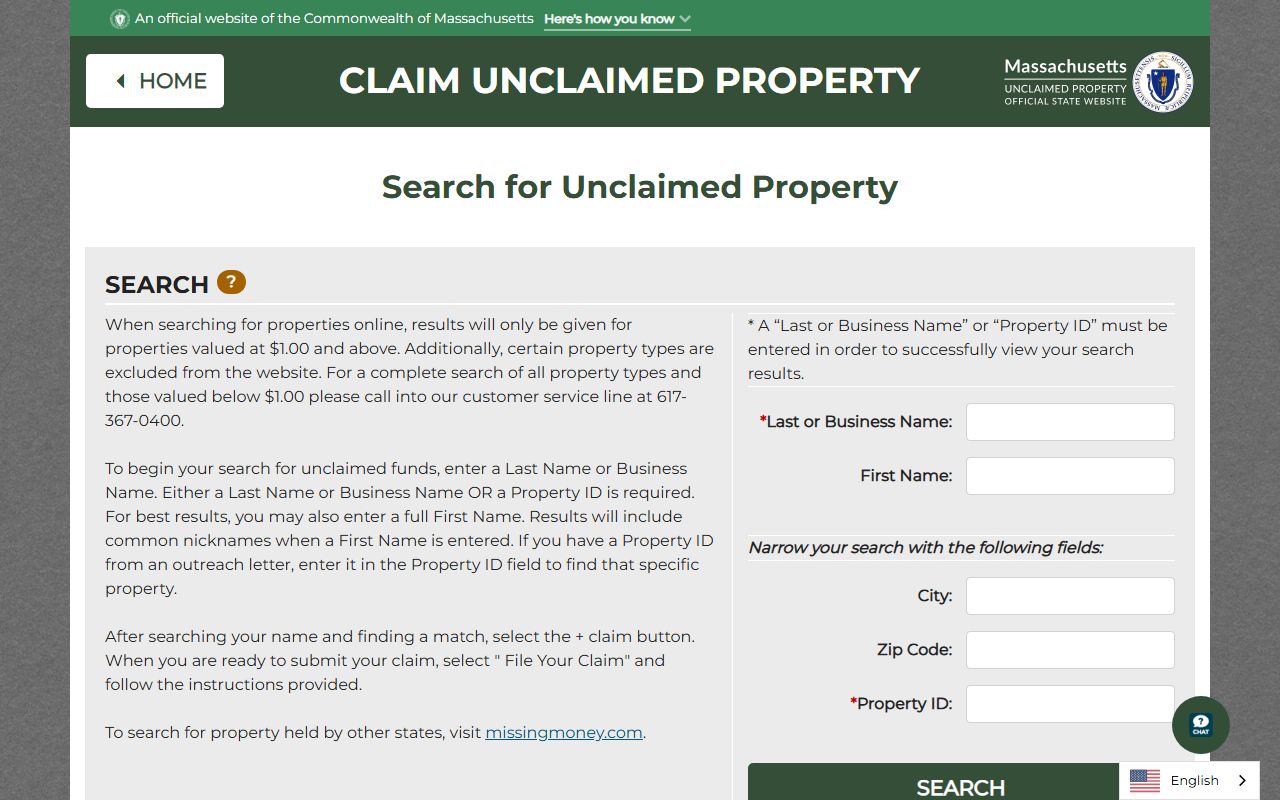
The state's search interface lets Fall River residents look up unclaimed funds by name, including property linked to past Fall River addresses.
Massachusetts Unclaimed Property Law
The legal framework for unclaimed property in Massachusetts is General Laws Chapter 200A. It covers every step: who reports property, when they must report it, how the state holds it, and how you get it back.
Section 5 deals with dormancy. For most financial accounts, the dormancy period is three years of no owner activity. After that, the holder tries to notify the owner. If they can't make contact, they remit the funds to the state.
Section 9A and Section 13 govern claims. The law says the state holds property in trust. Your claim right does not expire. It passes to your heirs if you never file.
The Unclaimed Property Division is part of the Office of the State Treasurer. The office is at One Ashburton Place, 12th Floor, Boston, MA 02108. Call (617) 367-0400 or use the toll-free line at 888-344-6277. The Division's information page is at Mass.gov. There is also a plain-language overview at mass.gov/how-to/find-unclaimed-property.
For residents who have lived in other states, run a parallel search at MissingMoney.com. That national tool covers multiple states and can turn up property reported outside Massachusetts.
Bristol County Unclaimed Money
Fall River is in Bristol County. The county page has more local resources and Registry of Deeds info for your area.
Nearby Cities
These nearby cities also have unclaimed money pages with local resources and search tools.