
Access Framingham Unclaimed Money
Framingham residents can search the Massachusetts Unclaimed Property Division's database for free to find dormant bank accounts, uncollected insurance proceeds, forgotten refunds, uncashed checks, and other abandoned assets tied to their name or a past Framingham address. The state holds over $3 billion in unclaimed funds from residents and businesses across Massachusetts, and a free search takes only a few minutes to run.
Framingham Overview
How to Search Unclaimed Money in Framingham
The official search tool is at FindMassMoney.gov, run by the Massachusetts State Treasury. Enter your name and run a search. Framingham became a city in 2018 after years as a town, so accounts tied to old Framingham addresses may appear under either town or city designations depending on the year they went dormant. Try searching under every version of your name you have used, including married and maiden names.
The claim search page shows results with the property type, original holder name, and the amount if it has been made available. Some records do not show an amount until you start a claim. The search tips page gives guidance on how to improve your results if your first search does not find what you are looking for.
Massachusetts estimates that about 1 in 10 residents has unclaimed property somewhere in the system. The average value of a claim runs from $1,250 to $2,080. Framingham is a sizable city with a diverse population and many long-term residents, which means there are likely many active claims tied to Framingham names and addresses in the state database.
The Framingham city portal at framinghamma.gov is the city's main site for local services and records. The site is shown below.
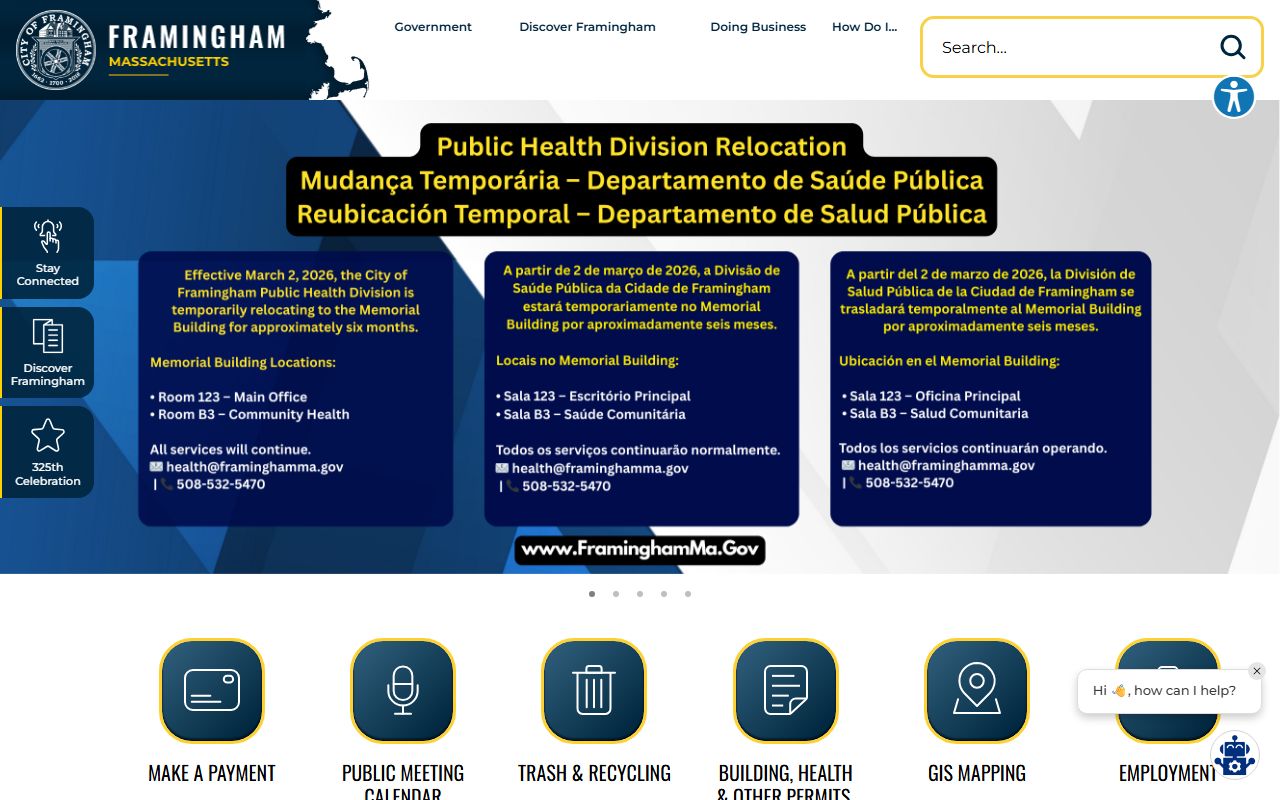
The city site provides contacts for local departments, including the City Clerk's office, which can assist with records needed to support a claim.
Framingham City Clerk and Local Records
The Framingham City Clerk's office maintains local public records including vital records such as birth, death, and marriage certificates. These records are sometimes needed when filing a claim for a deceased person's property. A certified death certificate and documentation of your relationship to the deceased are typically required when claiming as an heir or estate representative.
Framingham transitioned from a town meeting form of government to a city council government in 2018. This means some older records may be indexed under the Town of Framingham rather than the City of Framingham. If you are researching older property or account records tied to a Framingham address, the city clerk can help direct you to the right office or archive. Contact information is available at framinghamma.gov.
Property assessment records kept by the city can also help verify ownership during a specific period. If your claim is connected to a particular Framingham address, the assessor's office is a useful resource for confirming when and under what name a property was held.
Middlesex South Registry of Deeds
Framingham is part of the Middlesex South District for deed recording purposes. The Middlesex South Registry of Deeds is at 208 Cambridge Street, Cambridge, MA 02141. The phone number is 617-679-6300. You can search land records online at masslandrecords.com/MiddlesexSouth.
Deed records for Framingham properties can help you verify ownership during specific time periods. This matters when a claim is tied to a property address and you need to show that you were the owner or had a legal interest during the period when the property became dormant. Online searches are free, and certified copies of recorded documents can be ordered if you need them for a claim file.
The Middlesex South Registry covers a large number of communities, so search results will return records from across the district. Narrowing your search by address or parcel is the most efficient approach when you need Framingham-specific records.
How to File a Claim
After you locate a matching record on FindMassMoney.gov, click on it and follow the prompts to start your claim. The state's step-by-step guide is at findmassmoney.gov/app/claim/how-to-complete. For most individual claims, you need a valid government photo ID and one piece of proof of your current address. A utility bill, a bank statement with your name and address, or any piece of official mail is generally enough.
Claims on behalf of a deceased person take more documentation. You will need a certified death certificate, proof of your connection to the deceased, and evidence of your authority to handle the estate. Letters of administration from probate court, or a copy of a will naming you as executor, are the typical forms of authority documentation. The state reviews these more carefully, but valid estate claims are accepted.
Roughly one-third of claims move through an automatic approval process. The rest go to staff for manual review. The state targets 180 days for processing but many claims resolve sooner, especially when documentation is complete and clear. Approved funds are sent by check or direct deposit. Read the claiming FAQ for details on what happens after you submit.
Types of Unclaimed Property
Framingham residents may have unclaimed property from many different sources. Bank accounts that go inactive for three or more years are the most common category reported to the state. After the dormancy period passes and the holder is unable to reach the owner, the balance is turned over to the Massachusetts Unclaimed Property Division.
Other common types include uncollected insurance proceeds, stock dividends that were never picked up, utility refunds, security deposits, uncashed payroll checks, and court settlement funds that were distributed but never received. Safe deposit box contents from abandoned boxes are held separately as tangible property and can be searched at findmassmoney.gov/app/tangible-property.
For those who have lived or banked in other states, missingmoney.com is a useful tool that searches multiple state databases at once. The full Massachusetts program runs under M.G.L. Chapter 200A, which governs all aspects of unclaimed property in the state.
Massachusetts Unclaimed Property Law
The legal foundation for the unclaimed money program is Massachusetts General Laws Chapter 200A. This law defines what property becomes abandoned, how long the dormancy period is for different property types, and what steps holders must take before they can turn property over to the state. Section 3 applies to bank deposits. Section 5 covers insurance-related property. Section 7A addresses a broader range of property types.
Holders are required to make a good-faith effort to notify owners before remitting property to the state. They must send written notice and allow time for the owner to respond. If no response comes and the dormancy period expires, the property is reported and turned over. Once with the state, the funds are held with no time limit. There is no deadline to file a claim.
Searching and claiming are both free. You will never be charged a fee by the state to find or retrieve your property. The Unclaimed Property Division is at One Ashburton Place, 12th Floor, Boston, MA 02108. Phone: (617) 367-0400. Toll-free: 888-344-MASS (6277). The Mass.gov how-to guide and the Division's main page offer additional help.
Middlesex County Unclaimed Money
Framingham is in Middlesex County. Visit the county page for local Registry of Deeds info and more area resources.
Nearby Massachusetts Cities
These cities near Framingham each have their own unclaimed money resources page.